


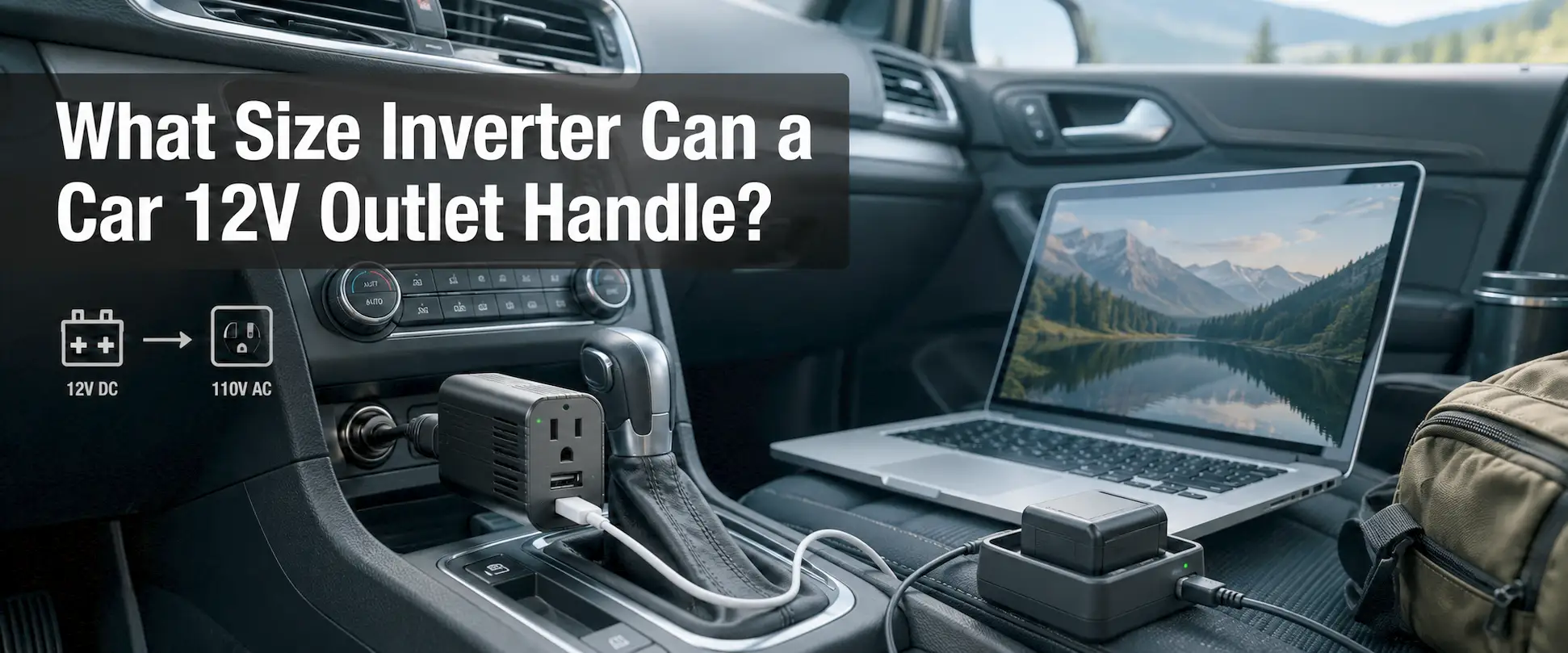

A 100- to 150-watt plug-in inverter is the practical size class for most cars, but the number on the inverter is not the real limit. The limit is the vehicle’s 12-volt outlet, fuse, and wiring. A 120-watt outlet may support roughly 100 watts of AC load after inverter losses. For extended use, staying closer to 80 or 90 watts provides a useful margin.
That is enough for many laptop chargers, camera battery chargers, radios, and other small electronics. A 300-watt inverter plugged into the same outlet does not create more available power. You are still limited to what the vehicle’s DC outlet rating allows.
As an Amazon Associate I earn from qualifying purchases (no extra cost to you).
This example gives you one household-style outlet without carrying a larger portable power station. For a simple road-trip setup, a compact model such as the BESTEK 150W Car Power Inverter is the right size class. It plugs directly into the vehicle’s 12-volt outlet and provides one AC outlet, a 30-watt USB-C port, and an 18-watt USB-A port. The plug can also rotate to fit different outlet locations.
The important part is keeping the actual load within your vehicle’s limit, rather than assuming all 150 watts are available.
Outlets differ, several sockets may share one circuit, and some devices draw extra power at startup. A few quick checks can prevent a blown fuse, hot plug, dead battery, or damaged device.
Start with the owner’s manual or the wattage printed beside the outlet. Do not assume every cigarette lighter socket can handle the same load.
A 10-amp circuit has a theoretical 120-watt limit because volts multiplied by amps equals watts. A 15-amp circuit has a theoretical 180-watt limit. However, that is DC power entering the inverter. Some power is lost while changing 12-volt DC into 110- or 120-volt AC.
The most common factory ratings found in current vehicles are 120 watts and 180 watts. Some vehicles, including several Ford models, provide a 240-watt, 20-amp power point.
| Vehicle outlet rating | Nominal current rating at 12V |
|---|---|
| 120 watts | 10 amps |
| 180 watts | 15 amps |
| 240 watts | 20 amps |
These examples are not a substitute for the rating printed beside the outlet or the limit stated in the vehicle owner’s manual.
These are maximum vehicle ratings, not recommended continuous loads. An inverter also loses some energy while changing 12-volt DC into household AC power.
My Subaru Outback Wilderness labels each 12-volt outlet for a maximum of 120 watts. However, Subaru also states that when two or more accessory outlets are used at the same time, their combined load must not exceed 120 watts.
Some vehicles use a shared total limit, so check whether the owner’s manual gives a per-outlet limit, a combined limit, or both.
A 120-watt limit is very common in modern cars and SUVs, but it is not universal. Some vehicles provide up to 180 watts, or 15 amps. A smaller number, including certain Ford models, provide 240-watt, 20-amp power points.
Based on the current vehicles I checked, 120 watts appears to be the most common rating. Always verify the exact limit for your vehicle, including whether multiple outlets share one combined limit.
A 150-watt car inverter is best for small electronics that use modest, steady power. However, the vehicle outlet may not let the inverter deliver all 150 watts. With a 120-watt outlet, keep the combined AC and USB load below the vehicle’s lower limit and leave some margin.
A 65-watt laptop charger is usually a reasonable load. Adding a phone and camera charger may bring the total close to the comfortable limit. Count every device connected to the inverter’s AC outlet and USB ports.
Good candidates include laptop chargers, camera battery chargers, small radios, LED lights, portable game systems, and low-watt tool-battery chargers.
Tip: If a device can run or charge directly from a vehicle’s 12-volt DC outlet, that is usually more efficient than using a power inverter plugged into the same outlet. An inverter adds another conversion step, which wastes some energy.
For example, I sometimes carry an EcoFlow DELTA 2 Max portable power station in the back of my Subaru. One common use is powering a 12-volt cooler. Although the EcoFlow can run my particular cooler for a very long time, I can replace some of that energy while driving by connecting the EcoFlow directly to the Subaru’s 12-volt outlet with its car-charging cable.
The EcoFlow car-charging input is limited to 8 amps. That equals about 96 watts at a nominal 12 volts. Because vehicle voltage is normally higher while the engine is running, the actual input may be closer to 110 watts. That still fits within the Subaru’s 120-watt limit.
👉 Top Features of EcoFlow DELTA 2 Max Portable Power Station
A modified sine wave inverter costs less and may work for basic chargers. A pure sine wave inverter produces cleaner AC power that more closely matches a household outlet.
Pure sine wave is the safer choice for sensitive electronics, audio gear, medical equipment, and devices that hum, run hot, or behave strangely.
For cleaner power, the BESTEK 300W Pure Sine Wave Power Inverter (Amazon) is a practical step up. It has two AC outlets and two USB charging ports, making it useful for laptops, camera equipment, radios, and other sensitive electronics.
Although the inverter is rated for 300 watts, that does not mean your car outlet can supply 300 watts. Keep the connected load within the limit listed in your vehicle owner’s manual. With most cigarette-lighter plug inverters, loads above about 150 watts require a properly fused connection directly to the battery.
Yes. An inverter draws from the starter battery whenever the outlet remains powered. The engine does not need to be running for the battery to lose charge.
A 60-watt AC load may require around 70 watts from the 12-volt system after inverter losses. That is close to six amps. An hour or two can remove meaningful energy from a starter battery, especially in cold weather or when the battery is weak.
A starter battery is designed for a short burst of current, not repeated deep discharge. For more than brief charging, use the inverter while driving or with the engine running outdoors.
First, find the outlet rating in the owner’s manual. If it says 120 watts, treat that as the total DC limit for the circuit, not guaranteed AC output.
Add the wattage of every connected device, including anything using the inverter’s USB ports. Leave a margin instead of operating at the limit.
Keep the inverter uncovered so air can move around it. Stop using it if the plug, cord, outlet, or inverter becomes unusually hot. A hot accessory plug may point to poor contact or too much current.
Make sure the plug fits firmly. A loose connection creates resistance and heat.
If the outlet stops working, check the vehicle’s accessory fuse. Replace it only with the exact rating specified by the manufacturer. A larger fuse may allow the wiring to overheat.
For charging a laptop, camera battery, radio, or other small device, a 100- to 150-watt car power inverter is the practical choice. The vehicle outlet rating still controls how much power you can use.
It has been my experience that getting a higher watt-rated product than what you will use it for – will mean less load and stress on the product itself. In other words, if your car’s DC outlet is rated at 120-watts, I would get at least a 150-watt rated inverter.
The rule is simple: size the load to the car outlet, not the inverter label. That one step prevents most blown fuses, overheated plugs, and disappointing results.
→ BESTEK 150W Power Inverter 12V DC to 110V AC (Amazon)
→ BESTEK 300W Pure Sine Wave Power Inverter 12V DC to 110V AC
Read the full article here
