


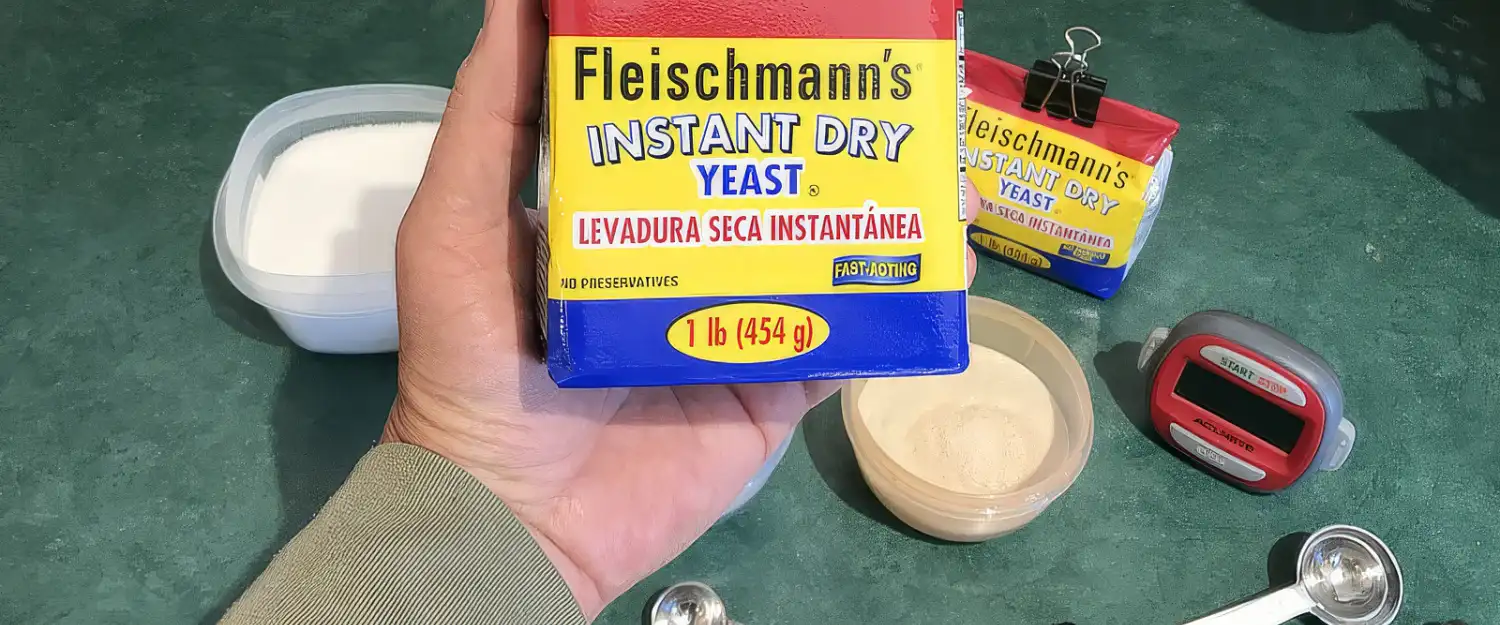

If you want to store dry yeast long term, keep it sealed, dry, and away from heat. Once the package is opened, cold storage is usually best. However, whether that means the refrigerator or freezer can depend on the brand of yeast.
For example, Fleischmann’s recommends storing opened dry yeast airtight in the back of the refrigerator. SAF Instant Yeast has different instructions. Red Star recommends storing an opened one-pound package of SAF Instant Yeast airtight in the freezer.
So there is no single fridge-or-freezer rule that applies to every package of yeast. Follow the manufacturer’s directions, keep moisture and air out, and label the container with the date you opened it.
I’ve also learned that properly stored yeast may continue working well beyond the date stamped on the package. I once tested yeast that was about six years old and compared it with a newer batch. Both still worked, although the older yeast had clearly lost some strength.
As an Amazon Associate I earn from qualifying purchases (no extra cost to you).
For opened yeast, I like using a small airtight container such as the OXO Good Grips POP airtight container. I’ve also saved the small four-ounce Fleischmann’s jars and reused them for yeast storage.
Once you break the original vacuum seal, air and humidity can begin working against the yeast. This is especially important with the larger one-pound packages because they may be opened dozens of times before they are used up.
Transfer opened yeast to a tightly sealed container unless the original package can be resealed very well. Keep the container dry. For even more assurance, label it with the date opened, and return it to cold storage after measuring what you need (don’t let it sit on the counter where it may collect moisture).
Here is a quick reference based on current manufacturer recommendations:
| Yeast | Unopened Storage | After Opening |
|---|---|---|
| Fleischmann’s dry yeast | Cool, dry pantry or refrigerator | Airtight container in refrigerator |
| SAF Instant Red, 1-pound package | Cool and dry, away from heat | Airtight container or freezer bag in freezer |
| Individual dry yeast packets | Cool, dry location until opened | Seal remaining yeast airtight and follow package directions |
| Fresh or cake yeast | Refrigerator | Refrigerator and use relatively quickly |
The manufacturer’s directions should take priority because different yeast products are packaged and formulated differently.
Two things are nearly universal: heat and moisture are bad for stored dry yeast.
For truly long-term storage, I also prefer keeping bulk packages sealed until I actually need them. Once opened, I divide the yeast into smaller airtight containers so the whole supply isn’t exposed every time I bake.
This is where yeast storage advice can get confusing.
Manufacturer recommendations differ. Fleischmann’s says to refrigerate its opened dry yeast, while Red Star specifically recommends freezing an opened package of SAF Instant Yeast.
Fleischmann’s recommends keeping its opened dry yeast in an airtight container in the back of the refrigerator. They say to use opened yeast within three to four months. They do not recommend freezing it.
SAF Instant Yeast is different. Red Star specifically recommends putting an opened package of SAF Instant Yeast in an airtight container or freezer bag and storing it in the freezer. Their recommendation is to use it within four months after opening.
Why do you sometimes hear that freezing can hurt yeast?
Part of the confusion comes from talking about different forms of yeast. Dry, inactive yeast is not the same thing as yeast that has already been hydrated and activated in bread dough. Freezing dough can damage some active yeast cells. That does not mean every package of dry yeast should stay out of the freezer.
This has changed how I look at the subject. Rather than saying the refrigerator or freezer is always best, I would follow the storage instructions for the particular yeast I am using.
For someone buying yeast in bulk, SAF Instant Yeast – Red Label, 1 lb (Amazon) is one popular option. Its freezer-storage directions are clearly provided by the manufacturer.
Most commercially packaged dry yeast has a date printed on the package. That date is the best place to start.
Fleischmann’s says sealed packages of dry yeast generally last around two years. Red Star says the “best if used by” date on SAF Instant Yeast is two years from the date it was packaged.
But a date on the package does not mean every yeast cell suddenly stops working the next day.
Yeast gradually loses activity as it ages. Poor storage speeds up that process. Heat, humidity, and exposure to air can shorten its useful life. Good storage can help preserve its leavening power.
This is why older yeast may still make bread rise, but not as strongly or as quickly as fresher yeast.
I have personally seen this with yeast stored for several years.
That does not mean I recommend ignoring the manufacturer’s date. It means that if you discover older yeast in your food storage, it may be worth testing before throwing it away.
I originally became interested in this subject after noticing that some homemade bread was not rising quite as much as expected.
Then I checked the yeast.
The package was about four years beyond its stamped date. Based on the manufacturing information, the yeast itself was approximately six years old.
That got my attention.
I went through some of our long-term food storage and found another older one-pound vacuum-sealed package. I also had a newer package that was about two years old.
So I decided to compare them under the same conditions.
I used the same amount of yeast, sugar, water, temperature, and time for both samples.
Both batches came alive and produced foam.
However, the newer yeast clearly produced more activity. The six-year-old yeast still worked, but it had lost some of its strength.
Image: 2-year-old yeast on the left. I was surprised that the 6-year-old yeast (right) rose as well as it did.
That was useful to see firsthand. Proper storage had kept the old yeast alive for years, but age was gradually taking its toll.
For long-term food storage, that is worth remembering. Yeast does not necessarily go from “good” to “dead” on one particular date. Its performance can decline gradually.
If you have older yeast and are not sure whether it is still active, test a small amount before using it in a loaf of bread.
Here is the simple test I used.
Mix 1/2 cup of warm water with 1 teaspoon of sugar. I use water at about 105°F.
Add 2 teaspoons of yeast to the water and wait about 10 minutes.
Active yeast should begin bubbling and develop a noticeable layer of foam on top.
If there is very little activity, the yeast may have lost too much strength to give you a dependable rise. If it develops a healthy cap of foam, you know there is still activity before committing flour and other ingredients to the recipe.
This becomes more useful as yeast gets older.
It also helps diagnose a loaf that suddenly does not rise the way it normally does. Sometimes the recipe is fine and the yeast is simply getting weak.
A good yeast storage container needs to do one main thing: keep outside air and moisture away from the yeast.
The small OXO airtight container mentioned earlier works well for this purpose. A glass jar with a tight-fitting lid also works.
I have saved several of the four-ounce Fleischmann’s yeast jars for this reason.
When I open a one-pound package, I can divide the yeast among those smaller jars. One pound fills approximately four of them.
I like the smaller-container approach because most of the yeast remains sealed while one jar is being used. You are not opening the entire supply every time you make bread.
This can be even more useful if your particular yeast is stored in the freezer. Repeatedly opening a large container can introduce warm, humid room air.
Whatever container you use, make sure it is completely dry before adding yeast.
Moisture is something you do not want inside a container of dry yeast.
Individual yeast packets are easy to store because they are already sealed into small portions.
Keep unopened packets in a cool, dry location and pay attention to the date printed on the package. A refrigerator is another option if recommended by the manufacturer.
If you open a packet and do not use all of it, don’t leave the remainder sitting loosely folded in the pantry.
Move the leftover yeast into a small airtight container or seal it very well. Then store it according to the manufacturer’s cold-storage directions.
A standard quarter-ounce packet of dry yeast contains about 2-1/4 teaspoons. That is useful to know when a recipe calls for one packet but you are measuring yeast from a larger container.
→ Yeast 2.25-Teaspoons Measuring Tool (Amazon)
For unopened dry yeast, a cool and dry storage location is usually fine until you are ready to use it. Heat is the enemy, so avoid hot cabinets or shelves near an oven.
Once yeast is opened, keeping it airtight becomes much more important.
For Fleischmann’s dry yeast, that means the refrigerator according to their instructions. For SAF Instant Yeast in the one-pound package, Red Star recommends the freezer.
For bulk storage, I also like dividing a large package into several smaller airtight containers. That way the entire supply is not exposed every time I need a few teaspoons.
And if you discover some very old yeast in your food storage, don’t automatically assume it is dead.
Test it first.
My six-year-old yeast was still alive. It simply did not have quite the strength of the newer yeast.
That’s the real advantage of storing yeast properly. You are protecting its ability to do the one thing that matters when you need it: make the bread rise.
👉 How Many Pounds of Flour or Wheat to Make Loaves of Bread
👉 Bread Recipe Without Yeast
Read the full article here
