


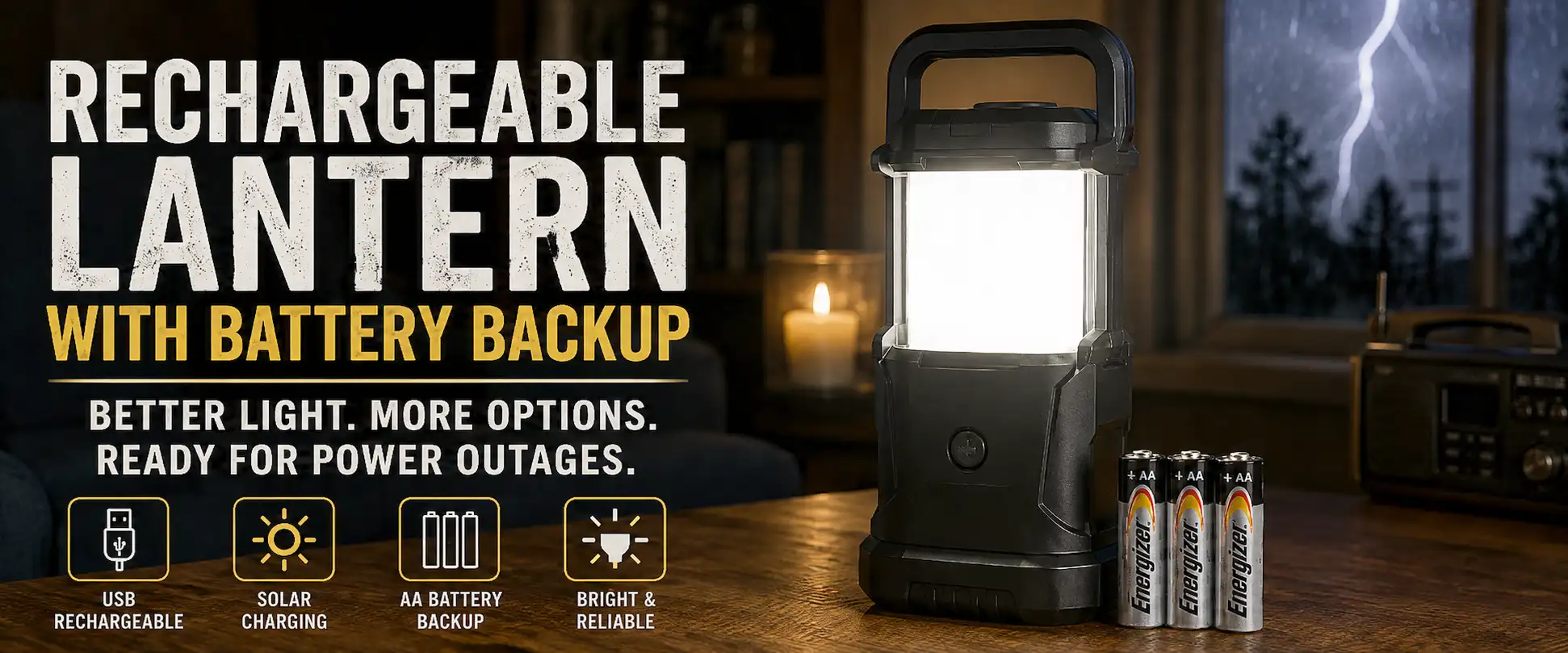

A rechargeable lantern with battery backup solves one problem that many emergency lights do not. You can use the rechargeable battery most of the time, but you are not depending on it.
If the power goes out and the lantern is only half charged, you can install ordinary batteries and keep going. That becomes much more important when an outage lasts longer than one evening.
For home emergency lighting, I like that arrangement better than depending only on a sealed rechargeable battery.
As an Amazon Associate I earn from qualifying purchases (no extra cost to you).
A good example is the Energizer S-500 Hybrid Solar Lantern. It has a rechargeable lithium-ion battery, USB and solar charging, plus the ability to run on three AA batteries. It produces up to 500 lumens on its rechargeable battery.
Rechargeable lanterns are convenient. Charge one with USB, put it on a shelf, and you have light without buying batteries every time you use it.
But emergency preparedness is different from normal use.
The question is not simply, “Does this lantern have a rechargeable battery?”
The better question is, “What happens when that battery is dead?”
Maybe you forgot to charge it. Maybe it was used during the previous outage. Maybe the power has already been out for two days and you have no easy way to recharge it.
A lantern that accepts ordinary batteries gives you another option.
That is the real advantage of a hybrid lantern. You are not betting your emergency lighting on a single source of stored energy.
Neither type is bad. They simply have different strengths.
A rechargeable lantern works very well when outages are short. It is inexpensive to operate, easy to recharge, and you do not keep throwing away disposable batteries.
A lantern powered by AA or D batteries has another advantage. When the batteries are exhausted, replacing them takes about 30 seconds.
There is no waiting for a charger.
Disposable alkaline batteries also store very well, which is another reason they make sense as backup power.
👉 What Batteries Don’t Leak? Best AA & AAA Batteries for Stored Gear
That makes ordinary batteries surprisingly useful for preparedness.
A hybrid lantern combines both approaches. Use the rechargeable battery first. Save your AA batteries as reserve power.
That is how I would use one during a blackout.
One mistake with emergency lanterns is concentrating too much on maximum lumens.
More light is not always better.
A 1,000 or 2,000 lumen lantern can light up a large area, but running it at full brightness also uses energy faster. For most indoor outage situations, you usually need comfortable room lighting, not stadium lighting.
Something around 50 to 150 lumens can be surprisingly useful once your eyes adjust to the dark.
You may want more light while cooking, cleaning up, checking the electrical panel, or moving around outside. That is where a 300 to 500 lumen high setting becomes useful.
The Energizer S-500 is rated at 500 lumens on high and also has a Low and Night Light setting. Energizer rates runtime at about 2.5 hours on high and eight hours on low.
One important distinction: USB and solar charge the lantern’s built-in lithium-ion battery. The AA batteries are a separate backup power source.
That illustrates something important.
Low mode is your friend during a long power outage.
If you only need enough light to move around the kitchen or sit in the living room, there is little reason to run a lantern at maximum output.
I use the same philosophy when considering a good flashlight for preparedness, especially one that includes a low mode of only 50 to 100 lumens.
I particularly like AA battery backup because AA batteries are already useful in so many other devices.
Flashlights, radios, thermometers, small electronics, wireless devices, and other emergency gear often use them.
That means you are not stockpiling a special battery that works with only one piece of equipment.
A modest supply of AA batteries can support several different emergency devices.
→ Energizer MAX AA Batteries (Amazon)
For a lantern that uses three AA batteries, keeping four or five spare sets nearby gives you 12 to 15 batteries dedicated to lighting.
I would keep those batteries beside the lantern rather than installed in it for years.
Battery manufacturers recommend storing unused batteries in a dry place at normal room temperature. It has been my experience that it is best to remove batteries from devices that will not be used for several months. This eliminates potential battery drain and battery leakage (although I have never had an Energizer MAX leak).
When an outage begins, you know exactly where everything is.
D batteries still have an important advantage: capacity.
A good D-cell LED lantern can run a very long time at lower brightness settings. That makes one useful for extended outages where charging might become difficult.
I already consider that a different type of emergency lighting strategy.
For longer outages, I still like a traditional D-cell LED lantern. Something like the Rayovac Sportsman 3D LED Lantern (Amazon) runs on three D batteries and is rated for about 70 hours on high, with even longer runtime on its energy-saving setting.
D cells are bulky, but that extra battery capacity can be a real advantage when there is no convenient way to recharge anything.
👉 Rayovac 3D LED Camping Lantern – Perfect Survival Gear Choice
For everyday storm outages, I like the flexibility of a smaller rechargeable lantern with AA backup. It is easier to move around the house, easier to feed with batteries you already stock, and rechargeable for routine use.
For a serious multi-day grid outage, having a long-runtime D-cell lantern in addition to the hybrid lantern would give you another layer of redundancy.
The important point is not to own the brightest lantern.
It is to have more than one practical way to keep producing light.
The small solar panel on the Energizer S-500 should be viewed as another backup, not necessarily your primary charging method.
The Energizer S-500 (Amazon) can recharge its internal battery from USB or its built-in solar panel. That gives you three possible energy sources: USB charging, solar charging, or AA batteries.
That is useful, but I would still charge it by USB before a storm whenever possible.
During an extended outage, the solar panel becomes more interesting. You can place the lantern in good sunlight during the day while saving your AA batteries for cloudy weather or nighttime use.
If you already own a portable power station or USB power bank, those give you even more ways to recharge the lantern.
This is where the hybrid design starts making sense.
Instead of one battery and one charging method, you have several options.
I would not depend on one giant lantern sitting in the middle of the house.
A better setup is several smaller lights.
Keep one hybrid lantern in a main living area. Keep another flashlight or headlamp where you can find it quickly. Then store spare AA batteries nearby.
👉 Headlamp or Flashlight?
When the power fails, run the lantern on its rechargeable battery first.
Use only as much brightness as you actually need.
If the rechargeable battery gets low, switch to AA batteries. If daylight returns before the outage ends, recharge the lantern from USB, solar, a power station, or whatever source you have available.
That approach stretches your stored energy much farther.
It also avoids the biggest weakness of a rechargeable-only lantern. If the internal battery goes dead, the AA batteries keep the hybrid lantern from becoming an expensive plastic paperweight until you can recharge it.
For emergency preparedness, I believe it is one of the better lantern designs.
A rechargeable lantern is convenient. A replaceable-battery lantern is dependable. A hybrid lantern gives you much of the advantage of both.
That does not mean you need a dozen lanterns or thousands of lumens.
I would rather have a reasonably bright LED lantern with several power options, a few sets of spare batteries, and a second independent flashlight.
When the lights go out, redundancy matters more than maximum brightness.
That is why a rechargeable lantern with battery backup makes so much sense for home power outages.
Read the full article here
