


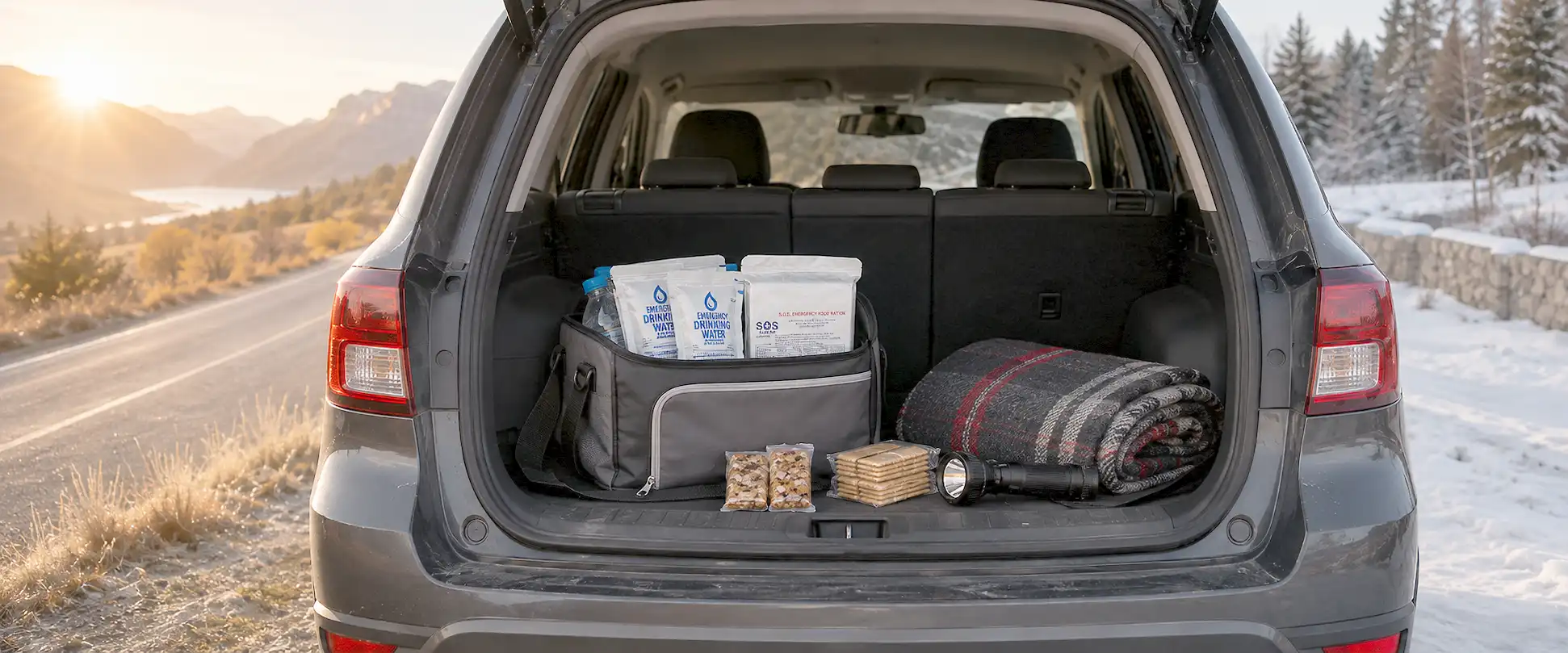

Do you keep a few things in your vehicle “just in case?” Food and water should be part of that kit, especially if you drive in winter weather, rural areas, or places where one accident can shut down a highway for hours. Especially that last one – ask me how I know…
For a true year-round vehicle stash, I would use a two-layer system: one heat-tolerant emergency ration that stays in the vehicle, plus a small supply of normal snacks that you rotate and actually like to eat.
This general two-layer method has been my approach for many years and has proven reliable.
One problem is heat. A snack that lasts a year in your pantry may not hold up nearly as well inside a parked vehicle. Cold creates its own problems too, especially with water and canned food.
That gives you dependable backup calories without turning your vehicle into a rolling pantry. It also avoids relying on ordinary granola bars, nuts, jerky, or canned food for years at a time.
For the long-term part of the kit, marine-style emergency ration bars make a lot of sense. They are compact, ready to eat, and made for emergency storage where conditions may be far from ideal.
As an Amazon Associate I earn from qualifying purchases (no extra cost to you).
→ S.O.S. Rations 3600-Calorie Emergency Food Bars
Each S.O.S. emergency ration package provides about 3,600 calories in nine fortified food bars. They are ready to eat, require no cooking or added water, have a five-year shelf life, and are U.S. Coast Guard approved. Product specifications list a storage temperature range of approximately -22°F to +149°F.
That is a much better fit for a vehicle than a bucket of freeze-dried meals. Freeze-dried food can be excellent emergency food at home, but most meals need water, a container, and often hot water. None of those are things I want to depend on while sitting in a traffic jam or stranded along a road.
I would still inspect the ration at least once or twice a year. A five-year shelf life does not mean we should forget that the package has been bouncing around inside a vehicle through hundreds of hot and cold cycles.
“Shelf-stable” does not mean “store it anywhere.”
The USDA recommends storing canned and other shelf-stable food in a cool, dry place (common sense). It also warns that temperatures over 100°F are harmful to canned goods and temperatures below 85°F are best for canned and shelf-stable foods. A parked vehicle can spend hours at temperatures far outside normal pantry conditions.
Heat is especially hard on foods that contain a lot of fat. Nuts, peanut butter, jerky, and many protein bars may still look normal while their flavor and quality slowly get worse. Chocolate-coated bars can turn into a sticky mess long before you need them.
This does not mean those foods are useless in a vehicle. It means I would treat them as rotating food, not permanent emergency food.
Keep a few normal snacks in the car if you use them. Eat and replace them every few months. Then keep the emergency ration separate and untouched unless you actually need it.
TIP: During summer, you can reduce heat buildup inside your vehicle by using a windshield sun shade.
For the rotating layer, choose foods that are dry, sealed, easy to eat, and not likely to melt. Crackers, pretzels, plain granola bars, dried fruit, and similar foods are reasonable choices.
I would avoid building the kit around foods that are oily, chocolate-covered, or filled with soft coatings. They may be fine for everyday use, but summer heat can make them unpleasant quickly.
The key is rotation. If you already eat a certain snack, put a few in the vehicle and replace them before they get old. You are much more likely to keep that system going than if you stock some strange “survival food” you never touch.
One simple habit is to refresh the snack layer when the seasons change. Spring and fall are easy reminders. The emergency ration stays put while the normal snacks get used and replaced.
Food gets attention, but water is the more urgent problem.
For backup water, individually sealed emergency water pouches make sense because they are compact and packaged for long-term storage.
→ Datrex Emergency Water Packets (Amazon)
Each pouch holds about 4.2 ounces of water, and Datrex lists a five-year shelf life. The water itself is probably not what limits the shelf life. I suspect that rating has more to do with how long the pouch and its seals are expected to remain reliable. Some reviewers also report that the pouches hold up well through freeze-and-thaw cycles. An 18-pack contains about 76 ounces, or 2.25 liters, altogether, so plan accordingly for how many you might want to keep in your vehicle.
For everyday driving, I like the idea of keeping normal bottled water and rotating it. I always have a Stanley water bottle with me (this one on Amazon), so that’s what goes in and out of the vehicle.
I would still carry more water when traveling through remote country, extreme heat, or winter weather. A few small pouches can get you through a short problem, but they disappear quickly if two or three people are in the vehicle.
You do not need a week of meals for normal driving. The better question is how long you could reasonably be stuck where you travel.
For most people, I would start with enough no-prep food to cover at least one long day. Something in the range of 1,200 to 2,000 calories per person gives you a useful emergency reserve without taking much room.
A 3,600-calorie ration gives you more flexibility. It provides a substantial reserve for one person during a longer delay, or two people could share it during a shorter emergency. Add rotating snacks and you have a practical buffer without filling the vehicle with food.
If you regularly cross mountain passes, drive isolated roads, or travel in severe winter weather, increase the amount. The same applies if children or other family members are usually with you.
The goal is not gourmet meals. It is enough energy to stay comfortable, think clearly, and avoid making a bad situation worse because everyone is hungry.
I would be cautious with canned food as a permanent vehicle supply. Heat is hard on canned goods, while freezing can expand the contents and possibly damage the seal.
MREs are useful emergency food, but I would not make them my first choice for a hot vehicle. Their storage life drops as storage temperature increases. They also take more room than a compact emergency ration bar.
Nuts, jerky, peanut butter, and many protein bars are better treated as rotating snacks. Their fats and oils can lose quality faster under repeated heat.
Freeze-dried meals are another good example. They store very well under proper conditions, but they are less convenient inside a vehicle because most require water and preparation.
A car kit should solve problems, not create more steps when you are already stuck.
My basic setup would be deliberately small.
Keep at least one 3,600-calorie emergency ration in the vehicle, and increase the amount if several people regularly travel with you. Add several familiar snacks that you rotate every few months. Keep normal drinking water aboard when practical, plus a few emergency water pouches as backup.
Store everything out of direct sunlight, preferably low in the vehicle or in the trunk.
You might use a small cooler. For example, I purchased a small cooler (Coleman 16 quart) that seemed about right to hold a decent quantity of food and some water bottles. A cooler can slow the temperature changes that occur inside a vehicle. Without ice, it obviously will not keep the contents cold, but the insulation can help moderate rapid temperature swings. That has been my approach for years.
Here’s a photo of one of my cooler setups while preparing an emergency food stash for a long road trip:
Write the expiration date where you can see it without unpacking everything. Check the kit in spring and fall for damaged packages, leaks, pests, and anything you forgot to rotate.
This is one of those preparations that may sit untouched for years. That is fine. The day a wreck closes the highway for six hours, a snowstorm stops traffic, or your vehicle breaks down far from town, a little food and water can make the situation much easier to manage.
👉 72-hour Emergency Kit
Read the full article here
