


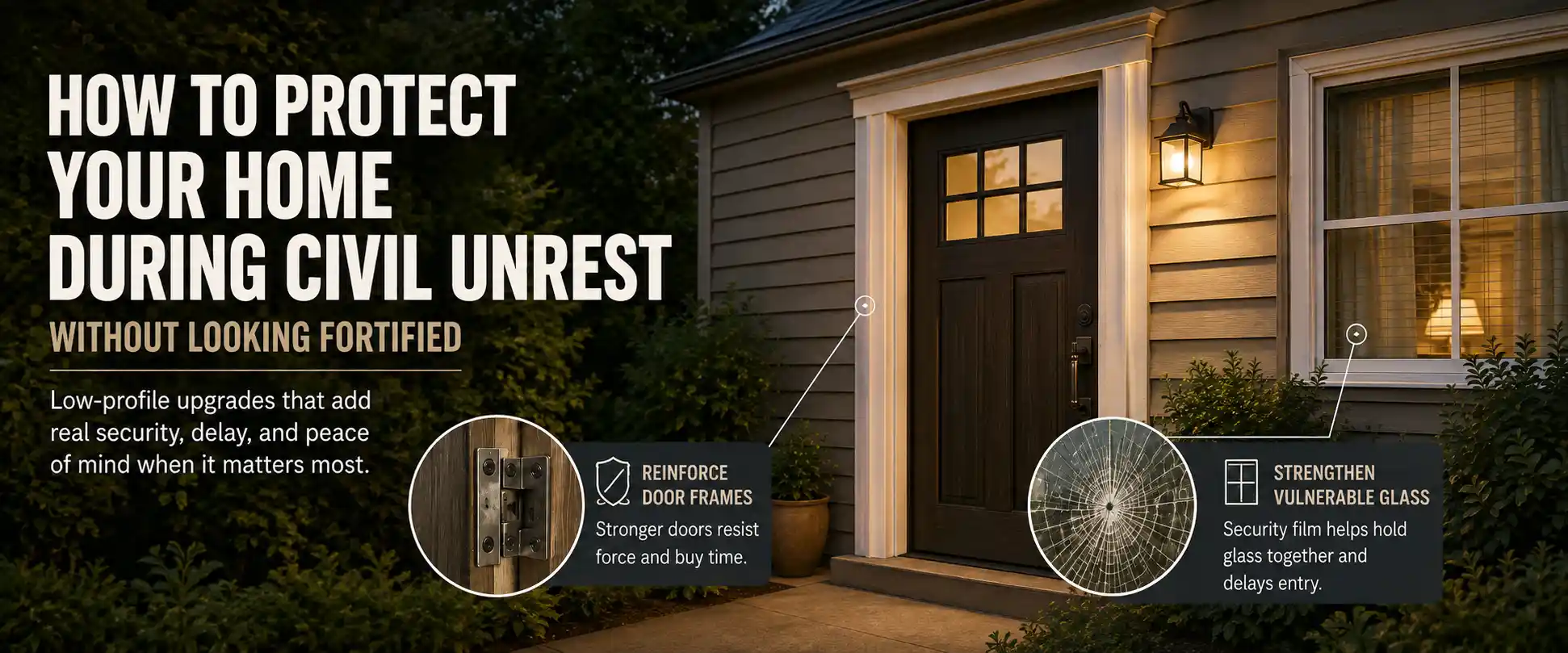

During civil unrest, the goal is not to turn your home into a fortress. The better goal is to make it a harder, slower, less attractive target while still looking like a normal house. Two upgrades do that especially well: reinforce the exterior door frame, and strengthen the easiest-to-reach glass.
That matters because many home-security upgrades are highly visible. Bars, heavy shutters, obvious barricades, and bright tactical-looking gear may improve security, but they also tell everyone that the house has been hardened. In a period of upheaval, I would rather have strength that is mostly hidden.
This kind of hardening has another advantage. It keeps working when the power is out, the internet is down, or a security service cannot respond quickly.
As an Amazon Associate I earn from qualifying purchases (no extra cost to you).
For the front and side doors, one product worth looking at is the Armor MAX 5 Piece Door Reinforcement Kit. It reinforces the jamb, lock area, and hinges while remaining mostly out of sight when the door is closed. You can also accomplish part of the same goal with a heavy strike plate and properly sized structural screws.
Think in terms of delay, not invincibility. A normal house cannot be made impossible to enter. What you can do is remove the easy entry points that invite a quick kick, pry, or smash-and-reach attempt.
A camera may tell you someone is outside. An alarm may make noise. Neither one physically slows the person down. That is why I put physical resistance ahead of adding yet another electronic security device. A reinforced door frame and tougher glass can buy time without changing the outward appearance of the house very much.
Low-profile security also means not drawing unnecessary attention to what you have. Keep expensive equipment, fuel cans, generators, stored supplies, and other signs of preparedness out of easy street view when possible.
A good deadbolt is important, but the weak part is often the wood around it. The lock can stay locked while the door jamb splits around the strike plate.
That is why a simple door inspection should start with the strike plate. Remove one of the screws and look at its length. I recommend screws about 3 inches long so the strike plate is anchored into the wall framing behind the jamb.
Do the same inspection on the hinge side. Longer screws through at least some hinge holes can tie that side into the framing too. The exact screw length depends on the door construction and what may be hidden nearby, so do not blindly drive a long screw into an unknown area.
A full reinforcement kit goes farther by spreading force over a much larger section of the jamb. That is the advantage of a product such as Door Armor. It strengthens several weak points at once instead of relying on a small metal plate around the deadbolt.
This is a good example of low-profile security. From the street, nothing has changed. The door still looks normal. The improvement only becomes obvious when someone tries to force it.
Security film does not turn an ordinary window into unbreakable glass. Its real value is that it can help hold broken glass together after impact, making a fast smash-and-reach entry more difficult.
That delay is useful around door sidelights, basement windows, ground-floor windows, and glass doors that would otherwise give quick access to a lock or interior space.
For a DIY option, the 8 Mil Clear Security and Safety Window Film (Amazon) is one product that fits this idea. It is clear, so it does not make the house look unusual from outside.
The important point is simple: security film is for delay. It may make an intruder work longer, make more noise, or give up. It is not something I would treat as a guaranteed barrier.
One other thing to understand is that the film is only part of the system. The glass can stay together after breaking but still pull away from the frame. For higher-risk windows, security film that is mechanically attached or bonded to the window frame provides a stronger barrier than film alone.
You probably do not need to film every window in the house. Start with the windows that offer the quickest path inside.
Look first at glass within reach of an exterior door lock. Then consider ground-level windows hidden from the street, basement windows, and first-floor windows on the side or rear of the house. A large second-story window is usually a lower priority than a small window beside the back door.
Walk around the house as if you had never seen it before. Which opening would you choose if you wanted to get inside quickly without standing in full view?
That question often identifies the priority better than buying the same security product for every room.
This is also where shrubs and stored items matter. Thick bushes can hide a window from neighbors. A trash can, table, wood pile, or air-conditioning unit can provide an easy step up to another opening.
During a tense period, there can be a temptation to make the house look aggressively defended. I think there is a point where that can work against you.
A home covered with warning signs, glaring floodlights, obvious cameras, stacked supplies, or visible backup equipment may send the message that there is something worth protecting.
That does not mean hiding all security. It means choosing security that looks ordinary.
Keep exterior lighting useful and familiar. Light the normal approaches to doors, parking areas, and walkways. I would rather have controlled, practical lighting than suddenly lighting the entire property like a commercial lot.
👉 I installed this solar outdoor motion light as another layer of home security
Cameras are useful for awareness and recording, but they are not a physical barrier. Mechanical door and window improvements keep working without an app, cloud connection, or subscription.
The best time to make these upgrades is while everything is calm. Trying to buy hardware, cut film, find tools, or repair a weak door after trouble is already nearby is poor timing.
Start with a quick weekend inspection:
- Check every exterior door for a solid deadbolt and a weak or loose jamb.
- Check the strike-plate screw length.
- Inspect hinge screws and loose hinges.
- Identify glass that gives easy access to a door lock.
- Pick the few ground-floor windows that offer the easiest hidden entry.
- Move valuable equipment and preparedness supplies out of obvious view.
Then make the two improvements that give the most benefit for your house. For many homes, that will be the main exterior door and one or two vulnerable glass areas.
If civil unrest or other upheaval reaches your area, avoiding trouble is still better than confronting it. Stay informed and have a plan for leaving if the situation becomes unsafe.
But if you are staying home, quiet physical security makes sense. Reinforce the door frame so a locked door is harder to force. Strengthen the most vulnerable glass so one strike does not instantly create easy access.
Neither upgrade makes a home invincible. That is not the goal.
The goal is to remove the easy options, add delay, and keep your house looking as ordinary as possible.
What would you add to this list? If you have made any low-profile security improvements around your home, especially ones that do not advertise themselves from the street, let us know in the comments.
Read the full article here
