



A U.S. Air Force flight enroute to Antarctica turned around to New Zealand after being notified of “potentially hazardous” space activity this week.
New Zealand’s Civil Aviation Authority was aware the flight from Christchurch pivoted following the agency’s issue of a Notice to Airmen, or NOTAM, to the aircraft, a CAA spokesperson told Military Times.
The Russian Air Traffic Management Corporation notified the CAA of the space activity, the spokesperson said, causing the authority to issue the NOTAM to the U.S. Air Force flight.
In a follow-up statement, the spokesperson said that the CAA was made aware by the Russian air traffic agency of a planned missile launch and associated potential hazard to international airspace within New Zealand’s Oceanic Flight Information Region.
“As a result, we put in place a danger area and issued a NOTAM to alert aircraft operators to the potential hazard,” the spokesperson said. “This does not prevent aircraft from flying through the area, operators make their decisions based on the information available.”
NOTAMs alert aircraft operators of potential hazards to allow them to make operational decisions around flight planning.
“Much of our Oceanic FIR is over international waters, where we have limited control over activities,” the spokesperson said, referring to the roughly 30 million square kilometers of international waters that spans across the South Pacific Ocean, Southern Ocean and Tasman Sea.
“It is normal practice for Airspace Authorities and Air Traffic Service Providers, provided with such hazard notifications to issue NOTAMs,” the spokesperson continued.
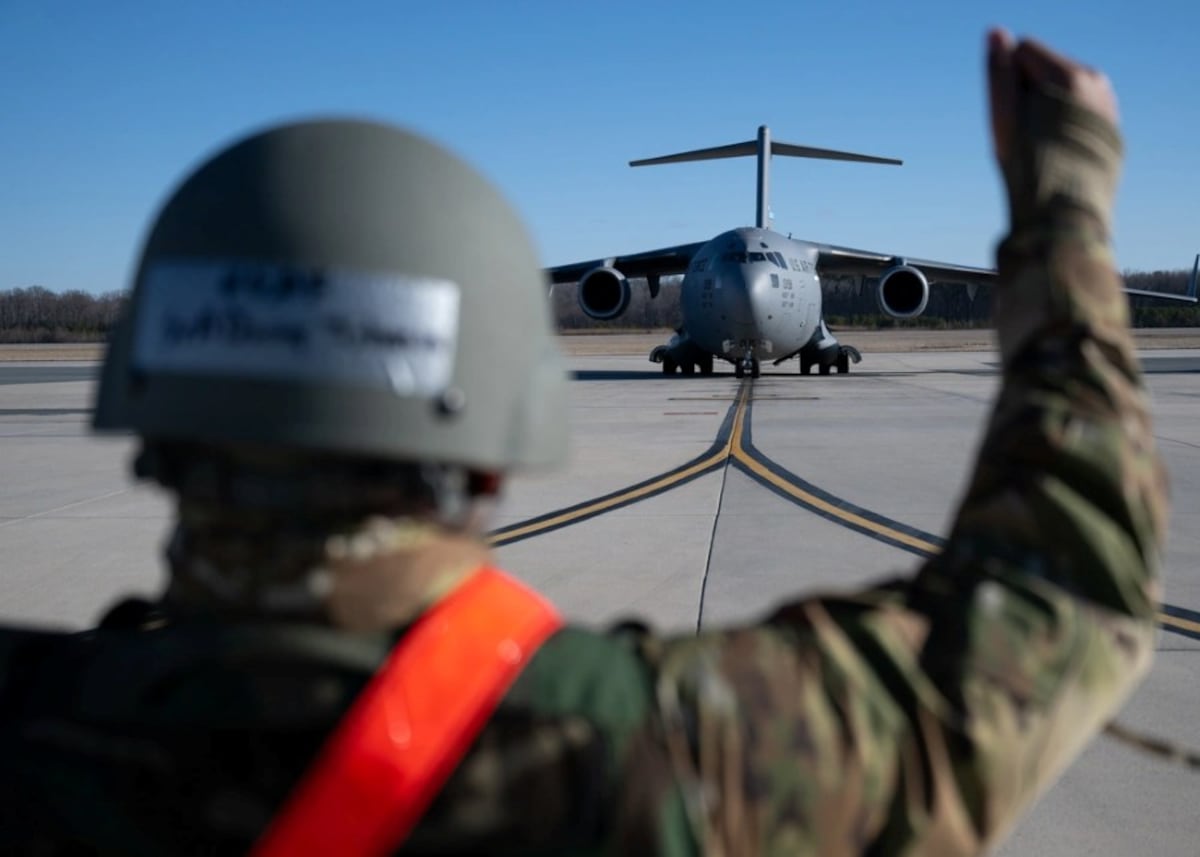
Flight-tracking data from Flightradar24 shows a U.S. Air Force C-17A Globemaster III took off from Christchurch International Airport, New Zealand, on Tuesday at 9 a.m. local time, with the call sign ICE28.
The site shows the aircraft landed around 11:30 a.m. back at Christchurch.
The flight was a routine resupply mission scheduled for this time of year, a U.S. Pacific Air Forces spokesperson told Military Times.
“Christchurch is the gateway to Antarctica,” the PACAF spokesperson said. “Both the United States Air Force and New Zealand Defense Force conduct operations and logistical support out of Christchurch in support of our Antarctic science programs.”
The turnaround happened during the U.S. Air Force’s annual Winter Fly-in period, or WinFly, which usually occurs toward the end of August and delivers teams, equipment and cargo to McMurdo Station and Scott Base, both in Antarctica, ahead of its research season.
The PACAF spokesperson declined to comment on whether this flight was in direct support of the WinFly, but a 2012 Air Force release details that a C-17 delivered over 300 passengers and 230,000 pounds of cargo that year to Antarctica.
“Using Christchurch International Airport, New Zealand as the base of operations, the mission of WinFly is to deliver advance teams and cargo to the remote research center in preparation for the main season of Operation Deep Freeze,” the release reads.
Operation Deep Freeze provides support to the U.S. Antarctic Program, managed by the National Science Foundation, that allows for continuous scientific research in the region.
Boeing’s C-17 Globemaster III is a cargo aircraft capable of fast delivery of troops and loads to main operating bases or forward bases in deployment areas. The aircraft can also complete tactical airlift and airdrop missions as well as aeromedical evacuations.
Cristina Stassis is a reporter covering stories surrounding the defense industry, national security, military/veteran affairs and more. She previously worked as an editorial fellow for Defense News in 2024 where she assisted the newsroom in breaking news across Sightline Media Group.
Read the full article here
