


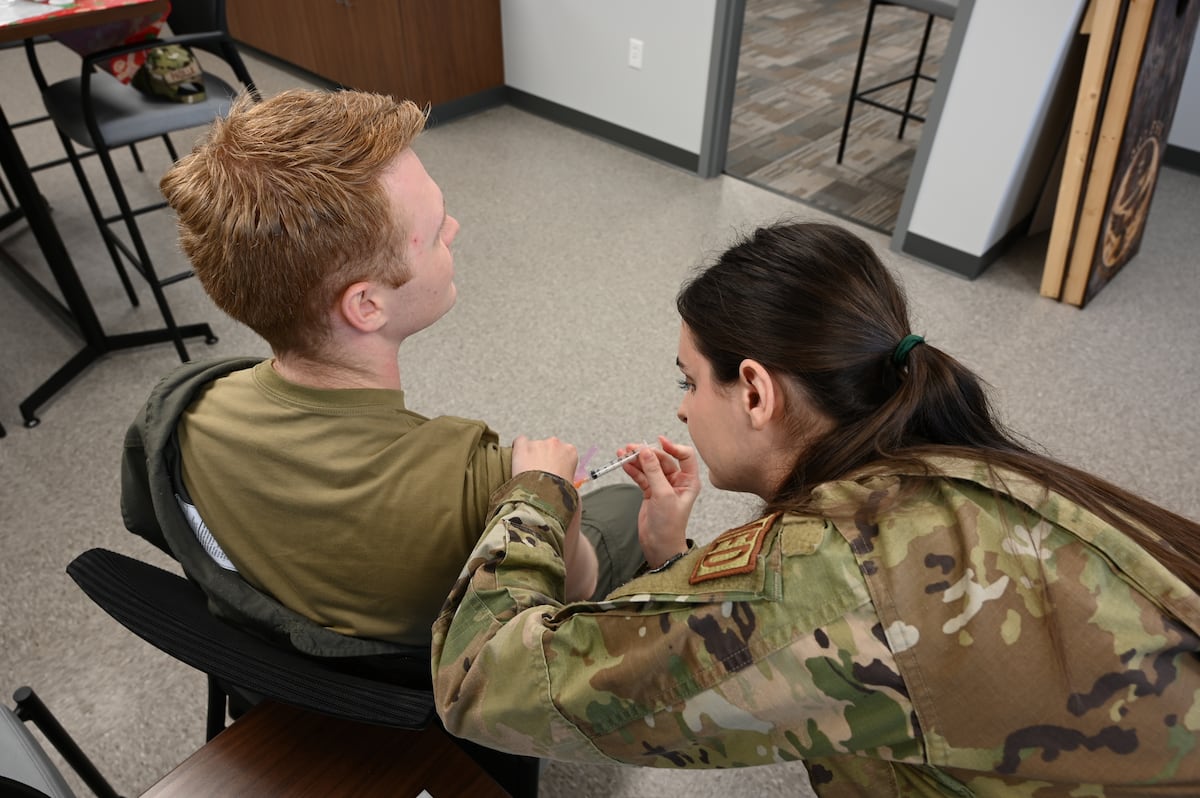

The U.S. military services are planning to ask for exceptions to Defense Secretary Pete Hegseth’s decision to allow military personnel to decide whether to get an annual flu vaccine, after years of requiring the shot.
Under Secretary of Defense for Personnel and Readiness Anthony Tata told senators Wednesday the department has solicited input from the services, which are now coming back “with a robust set of exception” requests.
Tata said the exceptions are “draft pre-decisional” and will be gathered by the department, reviewed and sent to Hegseth for final decisions.
“We are talking submarines, we are talking about ships, we are talking about basic training, we are talking about Ranger School,” Tata said.
During a Senate Armed Services Committee hearing on military personnel policy, Sen. Mazie Hirono, D-Hawaii, raised concerns over military readiness of the U.S. armed forces as a result of the change. Noting that the U.S. Army developed the flu vaccine to halt the spread of disease, she asked whether the DoD reviewed any studies that influenced the change.
“There’s such a thing as leadership that would say to the service members, ‘This is for your health protection. It’s science based,’” Hirono said.
RELATED
Tata said Hegseth made the decision — in consultation with his office and health affairs — “to get at is restoring trust and faith, restoring the warrior ethos.”
“What I’m aware of is troop morale and the significant backlash from the imposition from the Biden era of the COVID vaccine, and the mandatory COVID vaccine and the expulsion of lots of talent for refusing to take that vaccine,” Tata said.
Hegseth announced his decision to scrap the mandatory program in a post April 21 on the social media platform X.
He said the requirement was discarded “effective immediately,” adding that the “War Department is once again restoring freedom to our Joint Force.”
The flu vaccine has been required annually for U.S. military personnel since the 1950s to preserve the health of the force, although availability and operational requirements influenced the program from year to year. Generally, the Defense Department has aimed to inoculate more than 90% of active-duty personnel.
The program has been a major factor in lower rates of hospitalization among service members than national U.S. rates, according to an October 2025 Armed Forces Health Surveillance Division report.
The division found that the annual flu vaccine is effective in preventing the impact of flu on older service members and is important for protecting the health of the force, particularly in close quarters at recruit stations, which have the highest rates of flu infections each year across the services.
The incidence rate of hospitalizations for flu among recruits from 2010 to 2014 was 70 per 100,000, compared with the overall military rate of 7.4 per 100,000, according to the report.
“The higher burden of hospitalization among recruits offers DOD vaccine distribution priority considerations in the future,” wrote the report authors.
The Defense Department launched a mandatory program for troops to get the COVID-19 vaccine in August, 2021, although by the time the requirement was enacted, 73% of active-duty personnel had already received at least one dose of the vaccine.
At the time, more than 212,000 military personnel already had contracted COVID-19. A total of 96 troops died from COVID-19 between 2020 and 2022.
In early 2023, the Defense Department dropped a mandate for service members to get the vaccine for COVID-19 as a result of a law passed by Congress in 2022. Previously, more than 8,400 service members left the military rather than get the vaccine, with most citing health concerns or religious reasons.
Patricia Kime is a senior writer covering military and veterans health care, medicine and personnel issues.
Read the full article here
