


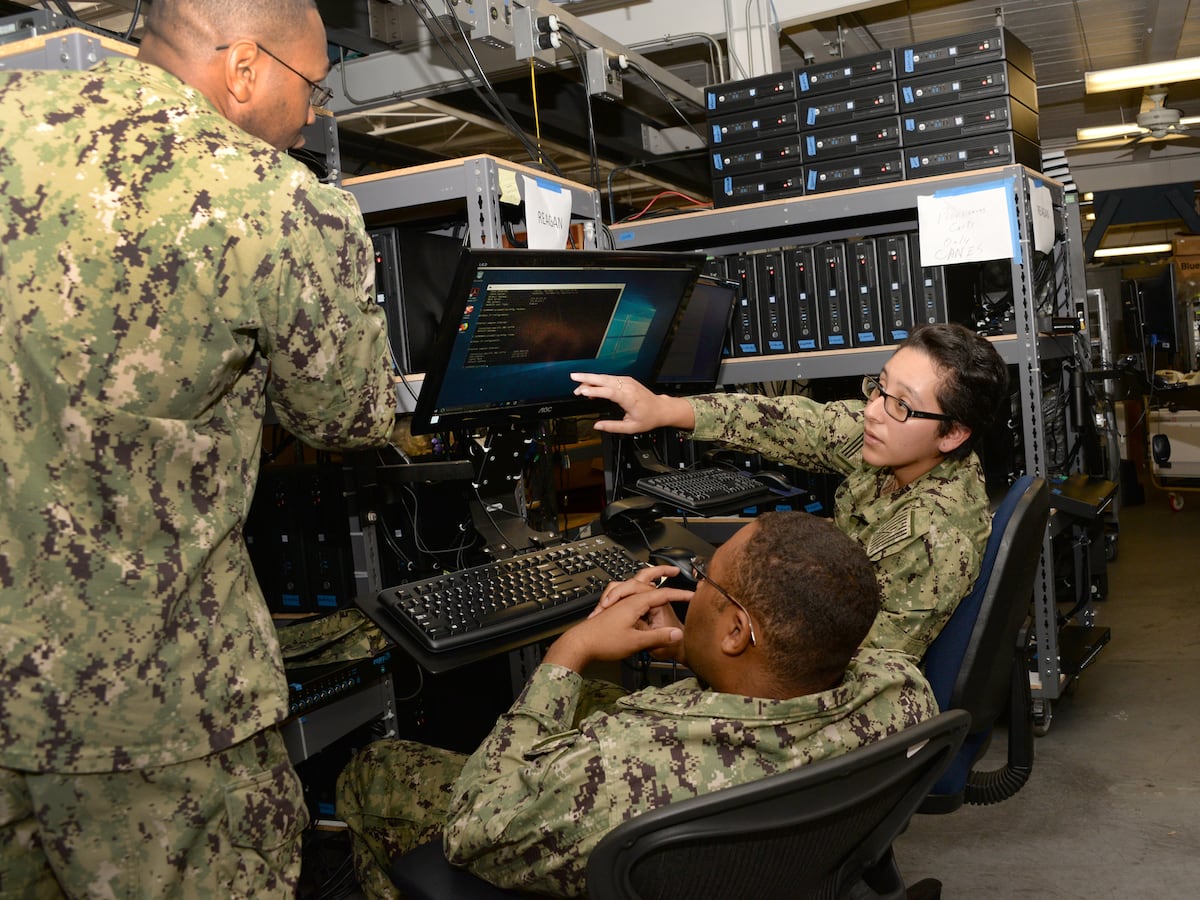

U.S. sailors tasked with protecting global communication networks and the flow of data will be given a new moniker for their career field, the Navy announced Sunday.
Service members previously known as information professionals will now be referred to as communications systems warfare officers.
“The title ‘information professional’ no longer captures the strategic reality of a community charged with stewarding our digital environment and delivering the maritime information advantage from seabed to space,” a Navy administrative message reads.
The career field, which has been around for 25 years, must adapt to the ever-evolving character of international conflict, and the title redesignation is a “direct warfighting imperative,” the service said.
Sailors serving in the position will continue to help secure network infrastructure, supervise the flow of critical data and “enable the kill.”
To be considered for a communications systems warfare officer commission, interested sailors must complete Officer Candidate School in Newport, Rhode Island, as well as several additional courses that prepare them to integrate into the information warfare community.
The service continues to focus on bolstering its technological depth with service members who can wield their unique expertise.
Professionals from the commercial sector who are adept at cybersecurity, offensive or defensive cyber operations and software engineering can now directly commission as an officer in the Navy Reserve in exchange for their talent, the Navy announced in June.
The focus on growing the service’s innovative sectors and wielding them to combat enemies goes back many years.
In 2022, the Navy created the Navy Innovation Center at the Naval Postgraduate School in Monterey, California, devoting energy toward the development of artificial intelligence and machine learning as adversaries invested in the now-seminal fields.
Riley Ceder is a reporter at Military Times, where he covers breaking news, criminal justice, investigations, and cyber. He previously worked as an investigative practicum student at The Washington Post, where he contributed to the Abused by the Badge investigation.
Read the full article here
