



Editor’s note: This story originally appeared on Laser Wars, a newsletter about military laser weapons and other futuristic defense technology. Subscribe here.
The U.S. Army hasn’t even officially taken delivery of its most powerful high-energy laser weapon yet, but the service is already walking away from it in pursuit of a newer model.
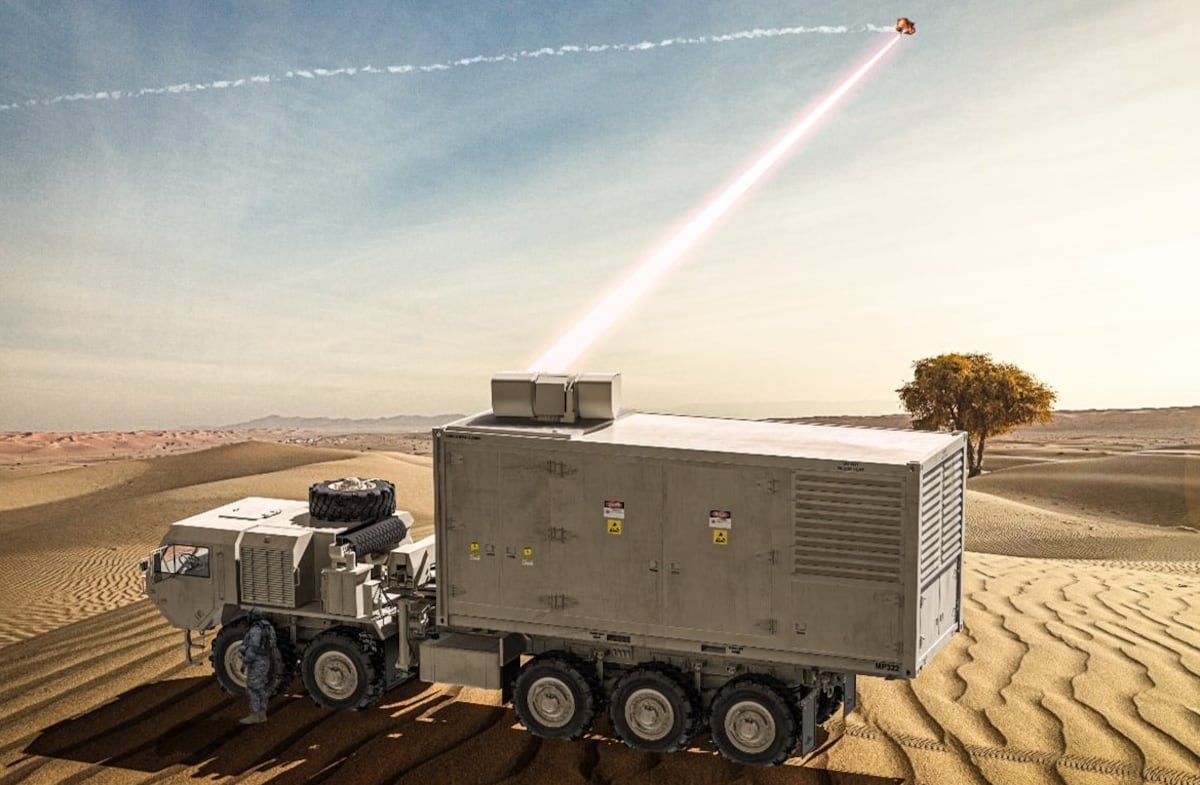
In a new Congressional Research Service (CRS) report published on March 9, Army officials revealed that the service no longer plans on transitioning its 300 kilowatt Indirect Fire Protection Capability-High Energy Laser system, or IFPC-HEL, dubbed “Valkyrie,” to a program of record after years in development.
This move effectively ends its current effort to build a laser weapon powerful enough to defend U.S. troops against cruise missiles as well as drones and munitions.
As recently as this past January, the Army planned to transition the truck-mounted IFPC-HEL — developed as a successor to the 100 kW High Energy Laser Tactical Vehicle Demonstrator (HEL-TVD) and earlier 10 kW High Energy Laser Mobile Test Truck (HELMTT) — to a program of record in fiscal year 2025 following successful testing.
The service previously awarded Lockheed Martin an Other Transaction Authority agreement worth up to $220.8 million in July 2023 to develop four IFPC-HEL prototypes following the September 2022 delivery of a 300 kW demonstrator under the U.S. Defense Department’s High Energy Laser Scaling Initiative (HELSI).
According to the new CRS report, however, Army officials said the IFPC-HEL contract has since been reduced to a single prototype, which is currently undergoing “final lab testing” at a Lockheed facility in New Jersey ahead of subsequent developmental testing at the service’s Dugway Proving Grounds in Utah this summer.
According to officials, that prototype won’t end up in the service’s hands until at least September, after which it will “be divested as a fielding candidate and used to inform the Joint Laser Warfighting System,” according to the CRS report.
In this context, the “Joint Laser Warfighting System” likely means the Pentagon’s Joint Laser Weapon System (JLWS), a new collaboration between the Army and U.S. Navy initiated “in support of DoD’s overarching Golden Dome for America strategy” to develop a laser weapon to “provide an Air Defense capability against cruise missile threats,” according to the Army’s fiscal year 2026 budget request.
The JLWS “represents the next step in the evolution of counter-cruise missile laser weapons,” the budget documents say.
The Army did not respond to a request for comment from Laser Wars.
While the Pentagon is accelerating the development and fielding of laser weapons at scale across the U.S. military primarily in response to the ever-expanding threat of low-cost weaponized drones, fast and maneuverable land-attack cruise missiles remain one of the most persistent and dangerous threats facing U.S. and allied forces abroad, from Russian strikes on critical infrastructure in Ukraine to Iranian-supplied weapons used across the Middle East.
This danger looms over the homeland as well; the U.S. Defense Intelligence Agency stated in 2025 that cruise missiles launched from Russian aircraft or Chinese naval assets represent a significant gap in America’s current domestic missile defenses.
Laser weapons like those envisioned for IFPC-HEL may struggle in a counter-cruise missile role. Unlike most drones, cruise missiles are designed to survive significant atmospheric friction as they speed towards their targets, often with hardened nose cones and reinforced casings that require sustained energy to defeat.
Because cruise missiles move at hundreds of miles an hour, maintaining a stable beam on a single vulnerable point over an extended range for several seconds in order to inflict catastrophic damage is significant challenge.
Even small disruptions in target tracking or beam quality can break the engagement, limiting the effectiveness of even the most powerful existing systems.One possible solution to this problem lies in pulsed laser technology, which delivers energy in high-intensity femtosecond-long bursts rather than a sustained beam like the popular continuous wave systems.
By concentrating energy into these ultra-short pulses, these systems can achieve higher peak power and potentially damage or disrupt targets without requiring prolonged dwell time on a single point.
IFPC-HEL wasn’t the U.S. military’s only counter-cruise missile efforts in the works. The Navy is still pursuing its 300 kW High Energy Laser Counter-ASCM Program (HELCAP), while the Office of Naval Research is exploring an even more powerful 400 kW system through its SONGBOW project.
Meanwhile, the Pentagon’s HELSI initiative is targeting megawatt-class lasers capable of engaging not just cruise missiles, but ballistic and hypersonic threats, with the department awarding nLight a contract in 2023 to develop a suitable system over three years.
According to a recent report in Aviation Week, nLight is “on track” to demonstrate that system for defense officials this year, with a successful outcome likely solidifying potential plans to incorporate laser weapons into the Golden Dome’s layered defense architecture.
It’s unclear from the CRS report why the Army chose to abandon IFPC-HEL. However, the decision mirrors its earlier move to drop the Stryker-mounted 50 kW Directed Energy Maneuver-Short Range Air Defense (DE M-SHORAD) laser weapon in favor of the upcoming Enduring High Energy Laser system, which may become the service’s first official directed energy program of record.
In that case, hands-on soldier assessments conducted in the Middle East in 2024 revealed that “results from the lab environment and test ranges were very different from the tactical environment,” according to a separate CRS update published March 10.
If a 50 kW system designed for drones like DE M-SHOARD struggles to perform outside of controlled conditions, scaling that technology up to 300 kW cruise missile defense may prove even more challenging.
The need for laser weapons capable of countering cruise missiles is clear, and the political and institutional will to develop them appears strong. But if the Army’s decision to move on from IFPC-HEL is any indication, the technology may not yet be ready for one of the most demanding missions in modern air defense.
Read the full article here
