


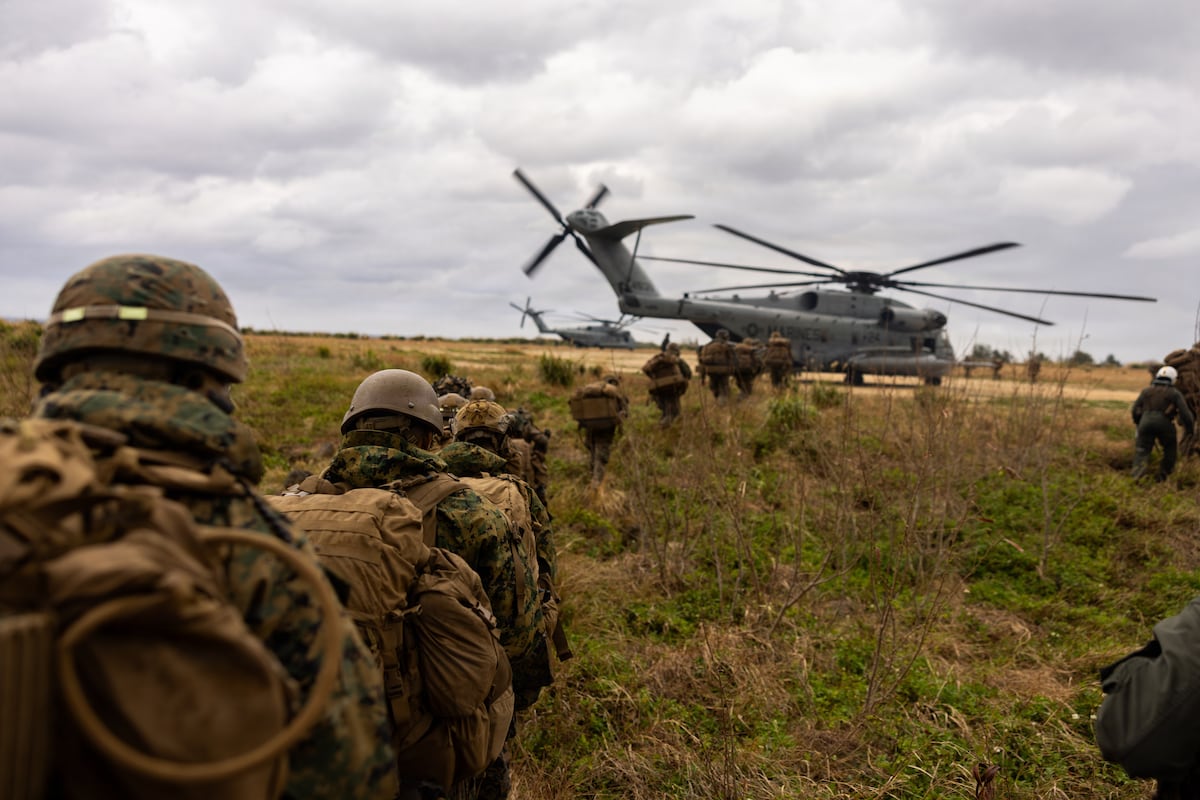

As the Chinese People’s Liberation Army edges toward its goal of invading Taiwan by 2027, experts argue that Washington must reexamine a long-standing U.S.-Japan blueprint that aims to shift nearly 10,000 Marines away from Okinawa.
The Defense Policy Review Initiative (DPRI) — intended to make the U.S. military presence less burdensome for the island’s residents — will instead dangerously weaken deterrence against Beijing, according to a report for the Atlantic Council from Lt. Col. Caleb Eames, a senior Marine Corps fellow, and Amy Cowley, an assistant director at the council’s Forward Defense program.
The time for the U.S. to adjust its posture is now, they write. The Pentagon has shown a willingness to dismantle entrenched programs and the Trump administration’s tariff policies have created leverage to agree to new terms with the Japanese government.
“Washington has a window of opportunity to rework old DPRI agreements in a new, substantial way,” Eames and Cowley argue.
Under the plan as it stands, the U.S. and Japan agreed to move 5,000 Marines and 1,300 dependents from Okinawa to Guam; 2,700 Marines and 2,000 dependents to Hawaii; 1,300 Marines to Australia; and 800 Marines to locations in the continental U.S. The first tranche of 100 troops, however, only arrived in Guam in 2024, despite the initiative being in effect since 2012.
“This move comes at a time when China is accelerating its bid for dominance in the western Pacific and pressing its claim on Taiwan,” they assert. “Unfortunately, if fully implemented, the DPRI would give Chinese military planners exactly what they want — a removal of U.S. forces from the locations where they would be most essential in a First Island Chain conflict.”
Okinawa sits along the so-called “first island chain,” stretching from the Japanese archipelago to the Malay Peninsula. It’s an arc of enormous strategic importance because U.S. military planners see it as a bulwark that helps them constrain China’s access to the western Pacific. The experts warn that shifting the American footprint 1,500 miles to the southeast, to Guam, would greatly hamper the capacity for a rapid response to Chinese aggression.
“Moving stand-in forces away from the First Island Chain now risks undermining their strategic deterrence at a critical juncture,” they contend.
At the apex of President Xi Jinping’s strategy lies a determination to reunify Taiwan with mainland China. Xi, in a phone call with President Donald Trump last week, described Taiwan as “the most important issue” of the U.S.-China relationship. He cautioned Trump to be prudent in supplying weapons to the island, according to a readout provided by China’s foreign ministry. The two leaders are poised to hold a high-stakes summit in China in April.
The Trump administration, in its 2026 National Defense Strategy, cast the Western Hemisphere as the U.S. military’s first priority — a contrast from both the president’s first term and from his predecessor, Joe Biden, who regarded Beijing as Washington’s principal adversary. The Pentagon said it aims to be “clear-eyed and realistic about the speed, scale, and quality” of China’s historic military buildup, but the goal is neither to “dominate,” nor to “strangle or humiliate them.” Instead, the strategy underscores ongoing U.S. diplomacy with China in tandem with “erecting a strong denial defense” in the Pacific.
The Marine Corps, meanwhile, insists that force realignments under the established DPRI framework will proceed on schedule.
“The United States Marine Corps maintains a steadfast commitment to honoring our nation’s obligations in the defense of Japan,” Capt. Steven J. Keenan, a spokesman for the Marine Corps, said in a statement to Military Times on Tuesday. “The Marine Corps is continuing to implement the realignment of U.S. forces in accordance with the DPRI Program of Record.”
Tanya Noury is a reporter for Military Times and Defense News, with coverage focusing on the White House and Pentagon.
Read the full article here
