


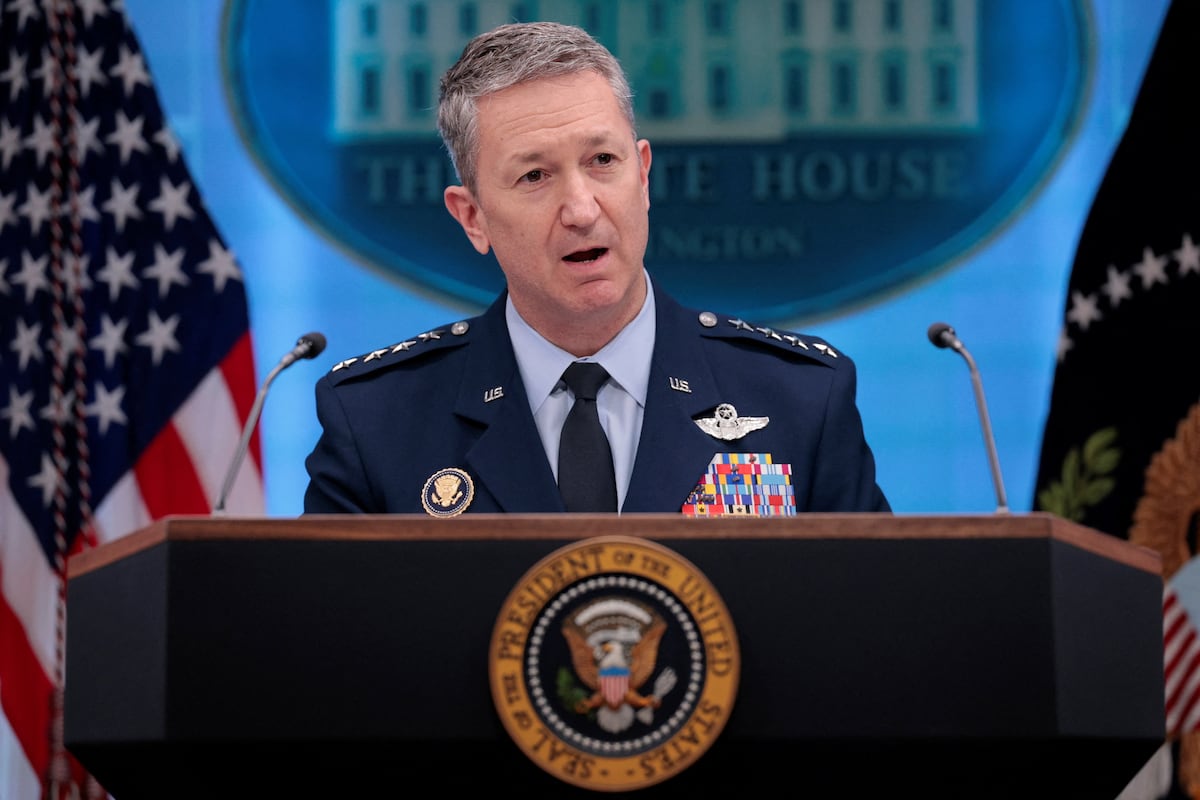

The recent exchange of fire between U.S. and Iranian forces in the Strait of Hormuz does not constitute a breach of the fragile four-week ceasefire, Gen. Dan Caine, the chairman of the Joint Chiefs of Staff, said on Tuesday.
Since the truce took hold, Iran has mounted more than 10 attacks on American forces, Caine told reporters at a Pentagon press briefing. But he characterized the hostile actions as “all below the threshold of restarting major combat operations at this point.”
Demarcating that threshold is “a political decision above my pay grade,” Caine said, before adding, “It’s low, harassing fire right now. It feels like Iran is grasping at straws.”
Caine also sounded a warning, saying: “No adversary should mistake our current restraint for a lack of resolve.”
The chairman of the Joint Chiefs of Staff was speaking in the wake of the Army’s AH-64 Apache and Navy’s MH-60 Seahawk helicopters reportedly destroying six small Iranian boats on Monday. The Islamic Revolutionary Guard Corps had threatened both U.S. and commercial ships with cruise missiles, drones and fast boats, Central Command said.
A senior figure in the Islamic Republic, however, has accused the U.S. of undermining the ceasefire and insisted that Tehran has yet to fully mobilize its capabilities.
“The new equation of the Strait of Hormuz is in the process of being solidified,” Mohammad Bagher Ghalibaf, the Speaker of the Iranian parliament, wrote in a post on X.
“The security of shipping and energy transit has been jeopardized by the United States and its allies through the violation of the ceasefire and the imposition of a blockade; of course, their evil will diminish,” Ghalibaf continued. “We know full well that the continuation of the status quo is intolerable for America; while we have not even begun yet.”
The latest salvo between the two adversaries comes as the Trump administration unveils “Project Freedom” — a separate initiative from Operation Epic Fury, according to Secretary of Defense Pete Hegseth — aimed at securing the free flow of commerce through the vital waterway.
Pentagon officials said that more than 22,500 mariners aboard over 1,550 commercial vessels were effectively stranded in the Gulf, awaiting transit through the strait.
As part of the naval operations, CENTCOM has established a layered defensive posture over the Strait of Hormuz, integrating Navy warships, Army attack helicopters, Air Force fighter jets and 15,000 service members deployed across the region.
Hegseth described the operation as America’s “gift” to the world, while emphasizing the mission’s impermanence for U.S. forces.
“Project Freedom is defensive in nature, focused in scope and temporary in duration, with one mission: Protecting innocent commercial shipping from Iranian aggression,” he said. “We’re not looking for a fight. But Iran also cannot be allowed to block innocent countries and their goods from an international waterway.”
“We expect the world to step up at the appropriate time, and soon we will hand responsibility back to you,” the defense secretary asserted.
Tanya Noury is a reporter for Military Times and Defense News, with coverage focusing on the White House and Pentagon.
Read the full article here
