


The Vietnam War involved all manner of fighters, the quality of which varied on both sides. The communists ranged from local Viet Cong guerrillas to professional People’s Army of Vietnam (PAVN) soldiers and between them, VC trained in the northerners’ light infantry tactics.
Besides the well-trained service personnel from the United States, Australia, Philippines and Thailand, South Vietnam’s formal Army of the Republic of Vietnam (ARVN) and less consistent anti-communist Civilian Irregular Defense Group (CIDG) forces frequently went into battle accompanied by a handful of American advisors. Among those American advisors was Jack Jacobs.
Born in Brooklyn, New York, on Aug. 2, 1945, to a Jewish family of mixed Greek, Polish and Romanian heritage, Jacobs spent his childhood in Queens, near LaGuardia Airport and later in Woodbridge Township, New Jersey. After graduating from Woodbridge High School, he earned a bachelor’s and master’s of arts at Rutgers University, while also training in the Reserve Officers Training Corps, from which he emerged with a second lieutenant’s commission in 1966.
Over the next two years he served as a platoon leader in the 82nd Airborne Division, battalion executive officer in the 7th Infantry Division and a battalion commander in the 10th Infantry Division in Panama. From there, he did two tours as a first lieutenant attached to Military Assistance Command, Vietnam (infantry), serving as an advisor to the ARVN.
March 1968 saw Jacobs attached to the ARVN as assistant commander to the 2nd Battalion, 16th Infantry, 9th Infantry Division. On March 9 his battalion was engaged in a search and destroy mission in Kien Phong Province. Just as it was getting in position to advance, however, the hunters became the hunted when the ARVN came under devastating fire from well-entrenched Viet Cong, some of whom were in well-positioned bunkers.
Jacobs called for air support and directed it as best he could, but as he moved up to the leading company, he found the battalion commander disabled and the troops — suffering heavy casualties — falling into disorganization.
Jacobs himself was struck by mortar fragments in the arms and head, which impaired his vision. Nevertheless, he took charge of the forward company and ordered a withdrawal to more secure terrain. Once his troops had established a defensive perimeter, he ran forward over rice paddies and open ground to evacuate a seriously wounded American advisor to a wooded area, where he administered first aid to him. Jacobs then ran forward again, to retrieve the battalion commander.
That done, he advanced several more times to rescue 12 more wounded ARVN and their weapons. As his citation noted, on three separate occasions he “contacted and broke off Viet Cong squads who were searching for allied wounded and weapons, single-handedly killing three and wounding several others….through his effort the allied company was restored to an effective fighting unit and prevented defeat of their friendly forces by a strong and determined enemy.”
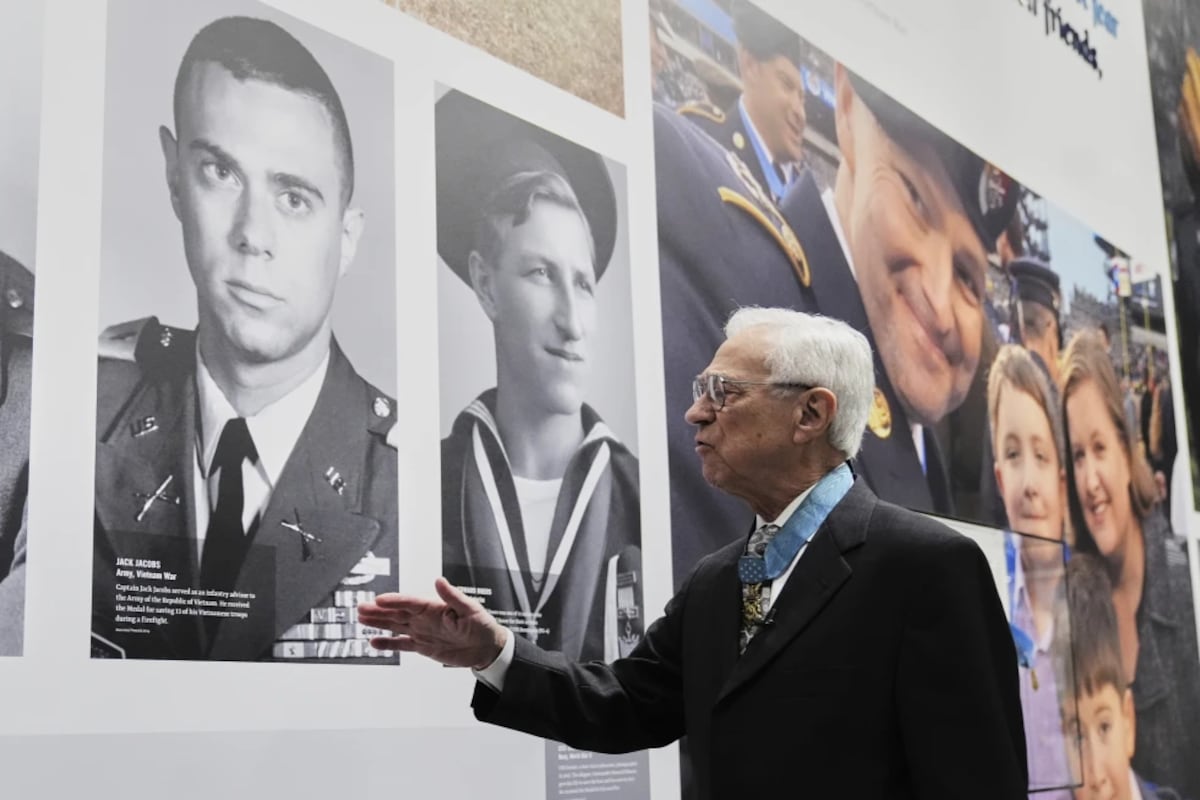
After the opposing sides disengaged, the courage and leadership Jacobs displayed in saving the 2nd Battalion from disaster resulted in his promotion to captain. Oct. 9, 1969, he was summoned to the White House where President Richard M. Nixon awarded him the Medal of Honor.
“As for my own action,” Jacobs would later recount, “the enemy had spies in the province headquarters. So they knew we were coming; they had three days to set up an ambush, and we walked right into it. We lost a large number killed and wounded in the first seconds of the battle, including me.
“There were a lot of other soldiers who were out in the open. I was badly wounded too, but I was the only person who was in a position to do something. I thought it was my obligation to do what I could to get them out of there. So I went out and dragged some of them back, carried some of them back. The Viet Cong were coming out of their bunkers with supporting cover, taking the weapons from our dead and shooting the wounded. I did that until I ran out of gas; I sat down to catch my breath and I couldn’t get up again because I’d lost too much blood.”
Additionally, by the end of his tours, he received the Silver Star with bronze oak leaf cluster, the Legion of Merit and Bronze Star with “V” device and two oak leaf clusters and two Purple Hearts.
“I don’t think you can judge valor with any kind of regularity or equitability,” Jacobs wrote. “It’s a subjective evaluation, despite the fact that the services have tried to judge it in absolute or relative terms…. You either did something valorous or you did not. It makes it more equitable but also more inequitable once you start instituting gradations of valor.”
From 1973 to 1976 Jacobs served as a faculty member of the U.S. Military Academy, teaching international and comparative politics. In 1987 he retired from the military as a colonel, then went into investment banking with various firms, including the Fitzroy Group in London. He was also vice chairman of the Medal of Honor Foundation, on the Board of Trustees for the National World War II Museum and McDermott Chair of Politics at the USMA.
In 2008 Jacobs wrote a memoir, “If Not Now, When?: Duty and Sacrifice in America’s Time of Need,” in collaboration with Douglas Century. It went on to win the Colby Award in 2010. In 2012 Jacobs and David Fisher co-wrote “Basic: Surviving Boot Camp and Basic Training.” In 2016 Jacobs was inducted into the New Jersey Hall of Fame.
Among other things, Jack is still active as a commentator at NBC and MSNBC, and in the Code of Support Foundation.
Read the full article here
