

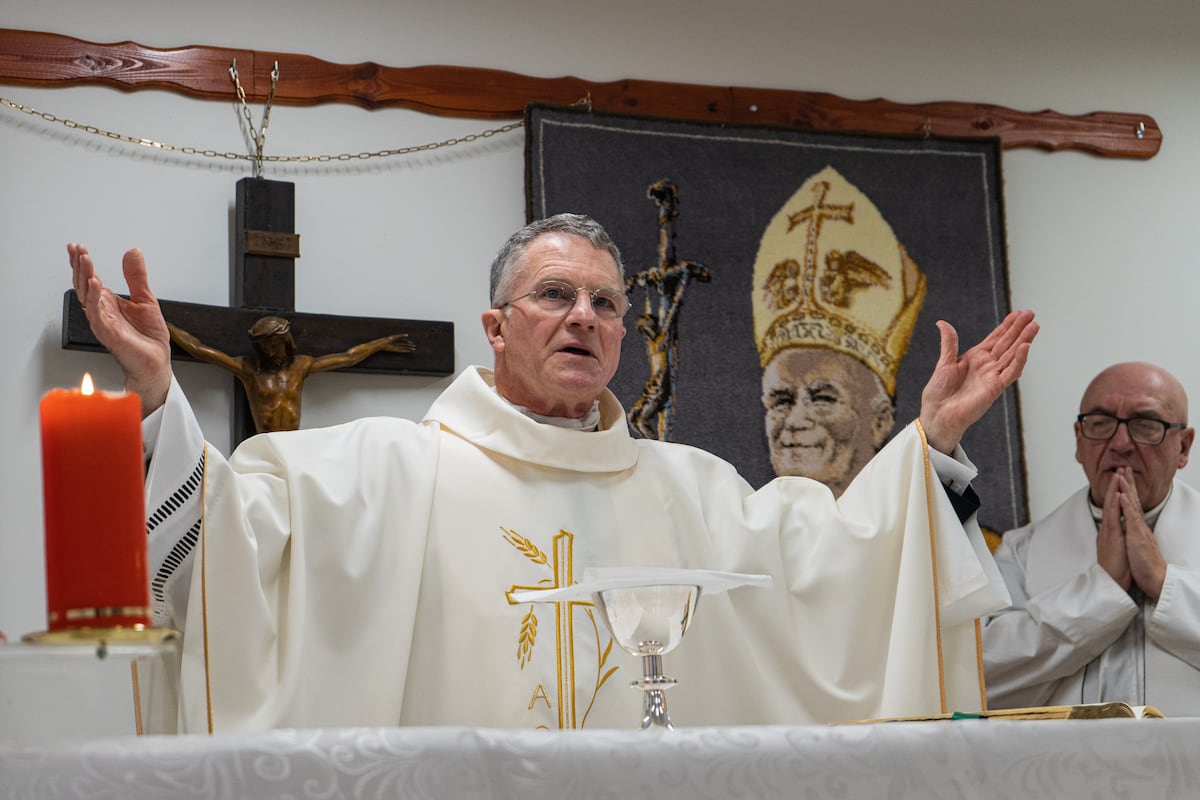

The Catholic archbishop responsible for U.S. military personnel said it is “morally acceptable” for service members to disobey an order if it is against their own conscience, as the Trump administration weighs possible troop deployments to Minneapolis, and the use of force to seize Greenland.
Timothy Broglio — who has served as the archbishop for the military services since 2007 — admitted in a BBC interview on Sunday that he was worried about the troops in his pastoral care “because they could be put in a situation where they’re being ordered to do something which is morally questionable.”
“It would be very difficult for a soldier or a Marine or a sailor to, by himself, to disobey an order … but strictly speaking, he or she would be, within the realm of their own conscience, it would be morally acceptable to disobey that order,” he said.
He went on to note, however, that such an isolated act of conscience would be “perhaps putting that individual in an untenable situation — and that’s my concern.”
Asked about President Donald Trump’s effort to annex Greenland, the autonomous Danish territory, Broglio echoed the condemnation voiced by the upper echelon of the Catholic church over the administration’s foreign policy.
“It does not seem really reasonable that the United States would attack and occupy a friendly nation,” he said. “I think it tarnishes the image of the United States in our world.”
Each service member swears an oath of enlistment to “support” and “defend” the constitution, not the commander in chief. Under U.S. military law, troops are required to disobey orders that are “manifestly” or “patently” unlawful, though such cases are legally complex. Brenner Fissell, vice president of the National Institute of Military Justice and professor of law at Villanova, emphasized the system is legal, not theological.
“The United States law does not track Catholic ethics,” Fissell said in an interview with Military Times. “There is a concept called conscientious objection, which is when you are opposed morally to war, but the United States does not recognize selective conscientious objections which is when you identify specific wars or deployments you don’t want to participate in.”
The distinction, Fissell said, carries consequences.
“When someone on the basis of religious faith chooses to violate the law, they are doing so knowing they are going to be punished,” he explained. “[When the bishop said that] he wasn’t saying ‘no one is going to suffer consequences for doing so.’”
“It’s a risk. What the law says is a service member disobeys the order at his or her peril — meaning he doesn’t get to know when he disobeys whether or not a court is going to back him,” Fissell said.
In Trump’s first year back in office, he launched strikes against Iran, Iraq, Nigeria, Somalia, Syria and Yemen; toppled Venezuela’s leader; and has ordered deployments of National Guard troops to nearly a dozen U.S. cities.
The president is also mulling invoking the Insurrection Act to quell anti-ICE protests in Minneapolis. The act allows an exception to the general prohibition on deploying the military among the civilian population in the United States. It can be invoked when disorder is so severe it “makes it impracticable to enforce the laws of the United States” — though the precise meaning of that language is open to debate.
Trump has declared his power as commander in chief is only constrained by his “own morality,” and, in terms of actions outside the U.S., has said that he is unbound to international law because he is “not looking to hurt people.” The White House maintains every military directive from Trump has met the required moral and legal standards.
“All of President Trump’s military orders have been moral and lawful,” White House spokeswoman Anna Kelly said in a statement to Military Times.
“The commander-in-chief has successfully utilized our military to arrest cartel head Nicolas Maduro, eliminate narcoterrorist drug boats, protect our wonderful Christians, obliterate Iran’s nuclear facilities and more,” she continued. “These actions have saved lives and made the entire world more stable.”
Tanya Noury is a reporter for Military Times and Defense News, with coverage focusing on the White House and Pentagon.
Read the full article here
